
Building with lime is an ancient architectural art that has experienced a massive revival in recent years. Whether you are restoring a centuries-old heritage property, constructing an eco-friendly modern home, or simply looking to replace synthetic paints with breathable, natural finishes, lime is the ultimate building material. It is flexible, environmentally friendly, and stunningly beautiful.
However, once you decide to use lime for your project, you are immediately faced with a crucial technical question: should you use hydraulic or non-hydraulic lime?
Choosing the wrong type of lime can lead to failing plaster, trapped moisture, and compromised masonry. While both materials share the same basic origin—limestone—their chemical properties, setting processes, and ideal applications are fundamentally different. Here is everything you need to know to make the right choice for your walls.
Understanding the Basics of Lime
Before diving into the differences, it helps to understand why lime is preferred over modern Portland cement. Cement is incredibly strong and sets quickly, but it is also rigid and impermeable. This means it traps moisture inside walls, which can lead to dampness, mold, and structural decay—especially in older buildings.
Lime, on the other hand, is “breathable” (vapor-permeable). It allows trapped moisture to evaporate harmlessly through the walls. It is also softer and more flexible than cement, meaning it can accommodate the natural micro-movements of a building without cracking.
To get these benefits, however, you have to choose the right binder. That choice comes down to the presence of natural clay impurities in the original limestone.
What is Non-Hydraulic Lime?
Non-hydraulic lime is the purest form of lime, made from limestone that contains virtually no clay or other impurities. It is often referred to as “fat lime,” “lime putty,” or “air lime.”
How It Works
The defining characteristic of non-hydraulic lime is how it cures. It does not set by reacting with water. Instead, it cures through a process called carbonation. As the wet lime is exposed to the air, it slowly absorbs carbon dioxide (CO2) and turns back into limestone. Because it relies entirely on air exposure, it sets very slowly. It can remain workable in a sealed tub for months or even years.
Key Characteristics:
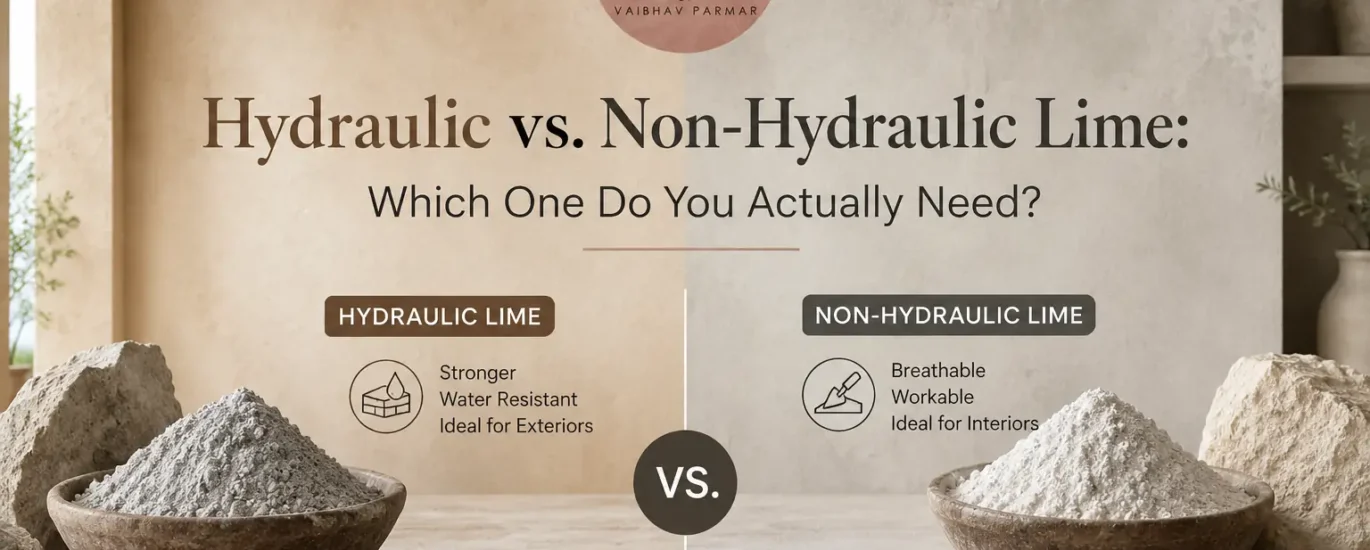
- Maximum Breathability: It is the most vapor-permeable of all lime products, making it exceptional for managing moisture in historic or natural buildings.
- High Flexibility: It is very soft and flexible, which prevents cracking.
- Slow Setting Time: It requires patience. It can take weeks to fully carbonate, and it must be protected from freezing weather or driving rain during this time.
- Aesthetic Appeal: It produces a beautiful, soft, and luminous finish that cannot be replicated by modern materials.
When to Use It:
Non-hydraulic lime is the material of choice for fine internal plasterwork, historic conservation of soft brick or stone, and traditional limewashes. Because it yields a beautifully smooth and workable paste, it is highly favored for luxury interior designs.
If you are looking to elevate your interior walls with a rich, breathable, and artistic finish, hiring a Premium Lime Plaster Service ensures that this delicate material is applied with the masterful technique required to bring out its best qualities.
What is Hydraulic Lime?
Hydraulic lime is made from limestone that naturally contains clay and other impurities (like silica and alumina). These impurities fundamentally change the way the lime behaves when mixed with water.
How It Works
Unlike pure fat lime, hydraulic lime sets through a chemical reaction with water (hydrolysis), followed by a secondary curing phase where it absorbs CO2 (carbonation). Because it undergoes a chemical set with water, it can harden in damp conditions—and even entirely underwater.
Natural Hydraulic Lime (NHL) Grades:
Hydraulic lime is categorized by its strength and setting speed, known as the NHL (Natural Hydraulic Lime) classification:
- NHL 2 (Feebly Hydraulic): Sets slowly and is very breathable. Used for internal applications or soft, permeable masonry.
- NHL 3.5 (Moderately Hydraulic): The most versatile grade. Used for general building work, external rendering, and pointing most brick and stone.
- NHL 5 (Eminently Hydraulic): The strongest and fastest-setting grade. Used for heavy structural work, retaining walls, paving, and areas exposed to severe weather or constant dampness.
Key Characteristics:
- Faster Setting: It hardens much quicker than non-hydraulic lime, reducing the time the work needs to be protected from the weather.
- Higher Compressive Strength: It is stronger and more durable, though this comes at a slight cost to breathability and flexibility.
- Moisture Tolerance: It cures effectively in damp, cold environments.
When to Use It:
Hydraulic lime is the workhorse of traditional exterior construction. It is used for external renders, roughcasting, and structural mortar. If you are constructing a new build or repairing an exterior wall, using the right grade of NHL is non-negotiable.
For structural masonry projects, the mortar must be carefully matched to the density of the building blocks. Partnering with the Best Brick Masonry Service will guarantee that your hydraulic lime mortar is mixed and applied correctly, ensuring your brickwork is both load-bearing and weather-resistant without trapping moisture.
The Verdict: Which One Do You Need?
Choosing between the two depends entirely on your specific application, the environment, and the materials you are working with.
Choose Non-Hydraulic Lime if:
- You are doing interior plastering.
- You are restoring an old building made of very soft stone or earth.
- You want maximum breathability and flexibility.
- You are applying a traditional decorative limewash.
- You have the time to allow for a slow curing process.
Choose Hydraulic Lime (NHL) if:
- You are doing exterior rendering or plastering.
- You are building structural walls or pointing brickwork.
- The work area is exposed to harsh weather, rain, or damp conditions.
- You are working in colder months where a faster set is required.
- You need higher compressive strength for paving or foundations.
Bringing It All Together
Lime is not a one-size-fits-all material. The beauty of lime lies in its versatility, but that versatility requires a deep understanding of building physics. A historic cottage will suffocate under strong NHL 5, just as a damp exterior retaining wall will cause pure non-hydraulic lime putty to fail and wash away.
For property owners and developers dealing with large-scale renovations or new builds, managing these material choices alongside architects, masons, and plasterers can be an overwhelming task. Sourcing the right materials and ensuring they are applied under the correct environmental conditions requires strict oversight.
To eliminate the guesswork and ensure your project runs smoothly from the foundation to the final decorative finish, utilizing comprehensive Turnkey construction Services is often the most efficient route. A turnkey approach means that experts handle everything—from selecting the exact grade of NHL for your exterior brickwork to sourcing the finest lime putty for your interior living spaces—delivering a structurally sound, beautifully finished, and highly breathable building.