
In the modern pursuit of energy efficiency, we have inadvertently created a problem. We build homes that are hermetically sealed, utilizing synthetic insulations, vinyl windows, and plastic-based paints to trap heat and cool air. While this is excellent for lowering utility bills, it has had a disastrous effect on the one thing we consume more than anything else: air.
Our homes have stopped breathing. The result is “Sick Building Syndrome,” a condition where stagnant indoor air accumulates volatile organic compounds (VOCs), excess humidity, and CO2, leading to a host of respiratory issues and general discomfort for occupants.
However, the solution to this ultra-modern problem lies in one of the world’s oldest building materials. It isn’t a high-tech air purifier or a mechanical ventilation system. It is the walls themselves.
At House of Lime, we champion the return to materials that work with nature rather than against it. Lime plaster is not merely a passive decorative finish; it is a chemically active, “living” skin for your building. It possesses the unique ability to absorb carbon dioxide, regulate humidity, and actively purify the air you breathe.
The Chemistry of Breath: The Lime Cycle
To understand how a wall can “clean” the air, one must first understand the chemistry of lime. Unlike modern cement or acrylic paints which cure through a hydraulic chemical reaction or solvent evaporation, lime plaster cures through carbonation.
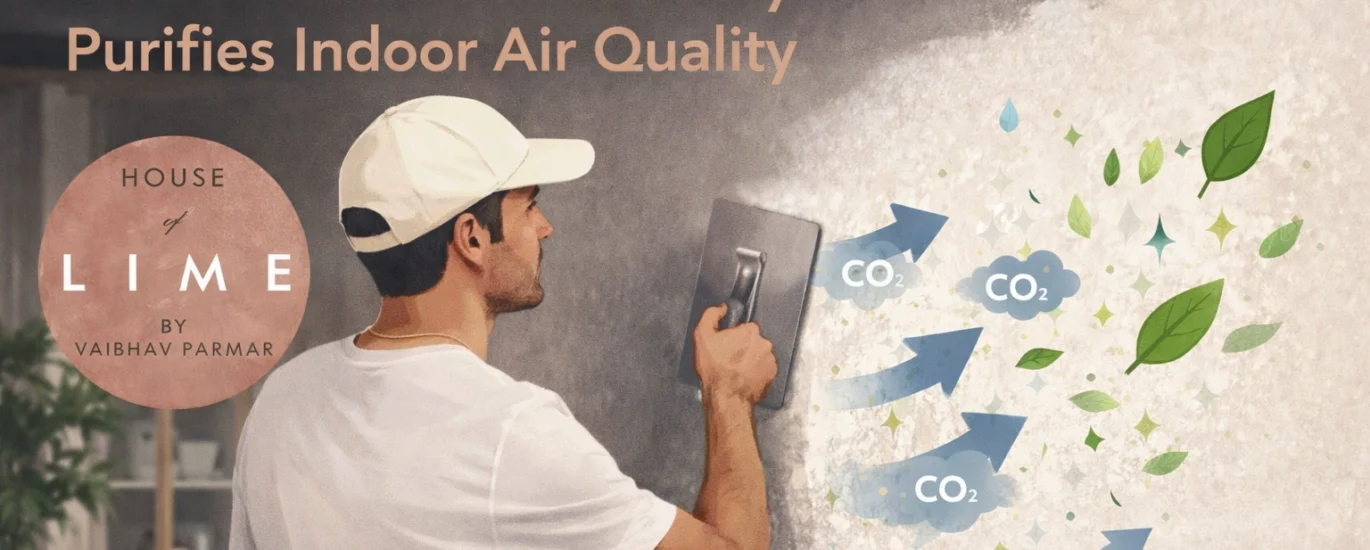
This process is known as the “Lime Cycle.” It begins with limestone (Calcium Carbonate), which is burned to create quicklime and then slaked with water to create lime putty (Calcium Hydroxide). When this putty is applied to your walls as plaster, it doesn’t just “dry.” It begins to absorb carbon dioxide (CO2) from the air to revert back into limestone (Calcium Carbonate).
This means that as your lime plaster cures—a process that can continue slowly for decades—it is literally inhaling the carbon dioxide from your living space and locking it away into the wall structure. It is a carbon-capture technology that has been used for thousands of years.
While a mechanical air filter pushes air through a mesh, lime plaster transforms the entire surface area of your interior—walls and ceilings—into a carbon-absorbing sponge. This slow chemical exchange does more than just harden the wall; it fundamentally alters the atmosphere of the room.
The “Lungs” of the House: Hygroscopic Action
Beyond carbon absorption, the single greatest contribution lime plaster makes to indoor air quality is its hygroscopic nature. In layman’s terms, lime plaster allows a building to “breathe.”
Modern acrylic paints and cement plasters are often impermeable. They trap moisture inside the walls or keep humidity suspended in the air. When indoor humidity rises—due to cooking, showering, or simply breathing—impermeable walls force that moisture to sit on surfaces, creating the perfect breeding ground for mold and mildew. Mold spores are a leading cause of indoor allergies and respiratory distress.
Lime plaster, however, is highly permeable (vapor open). It acts as a humidity buffer. When the air in the room is too humid, the microscopic pore structure of the lime absorbs the excess moisture, pulling it away from the surface. When the room becomes dry, the lime releases that moisture back into the air.
This natural regulation keeps indoor humidity levels in the “Goldilocks zone”—typically between 40% and 60%. This range is crucial because viruses, bacteria, and mold struggle to survive in this humidity bracket. By naturally maintaining this balance, lime plaster passively sanitizes the environment, reducing the viral load and preventing the damp conditions that mold requires to thrive.
Eliminating the VOC Threat
Walk into a newly painted modern home, and you are hit with that “new house smell.” That smell is actually the off-gassing of Volatile Organic Compounds (VOCs) such as formaldehyde, benzene, and acetone. These chemicals are found in standard latex paints, synthetic carpets, and engineered wood products. They can continue to off-gas for years, contributing to headaches, dizziness, and long-term health risks.
Lime plaster is an inert, natural material. It contains zero VOCs. But its benefits go further than just being non-toxic itself. Due to its high alkalinity (high pH level), lime has a natural antiseptic quality. It is resistant to fungus and acts as a deterrent to small insects.
For families suffering from asthma or chemical sensitivities, replacing synthetic paints with a natural lime finish is often the most effective modification they can make to their living environment. It removes the chemical load from the largest surface area in the home.
The Intersection of Health and Heritage: Araish
When people think of “healthy” or “eco-friendly” materials, they often picture rough, rustic, or “earthy” aesthetics. While lime can certainly achieve that wabi-sabi look, it is also capable of the highest levels of refinement and luxury.
This is best exemplified by the traditional technique of Araish Plaster in India. Originating in the royal courts of Rajasthan, Araish is a specialized form of lime plastering that uses marble dust and rigorous burnishing to create a surface as smooth as glass.
Historically, this technique was used in palaces not just for its breathtaking beauty, but for its thermal properties. The compressed, smooth surface is cool to the touch, helping to passively cool interiors in the scorching heat.
Today, Araish represents the perfect marriage of luxury design and health-conscious living. It proves that you do not have to sacrifice a high-gloss, sophisticated aesthetic to achieve a breathable, non-toxic home. At House of Lime, we are dedicated to preserving this artisanal craft, bringing the royal finish of the past into the modern healthy home.
Sustainability Beyond the Home
The air quality benefits of lime plaster extend beyond the four walls of your house. The production of lime is significantly less energy-intensive than the production of Portland cement.
Cement production is one of the world’s largest producers of CO2, requiring massive kilns heated to extreme temperatures. Lime is burnt at lower temperatures, and because it re-absorbs CO2 during its curing process, its lifetime carbon footprint is vastly lower.
By choosing lime, you are making a choice that cleans the air inside your home while simultaneously reducing the carbon emissions pumped into the global atmosphere. It is a material that is kind to the micro-climate of your living room and the macro-climate of the planet.
Planning for a Healthy Home
Integrating lime plaster into a modern build requires more than just buying bags of lime; it requires a shift in how we view the “envelope” of the building. It changes how we spec insulation, how we detail windows, and how we manage moisture barriers.
This is why it is crucial to engage with an expert early in the project. As an Architectural Design Consultant, House of Lime works with architects and homeowners to ensure that the specification of lime is done correctly. We help navigate the complexities of substrates—determining whether you need a traditional 3-coat system on masonry or a modern thin-coat application on drywall.
We also assist in color and texture selection. Because lime is colored with natural mineral pigments rather than synthetic dyes, the color palette is nuanced and earthy. The light refraction on a lime wall is different from paint; it has a depth and luminosity that flat paint simply cannot mimic. Consulting with specialists ensures that these aesthetic choices align perfectly with the functional health goals of the project.
The Importance of Skilled Application
The one “catch” with lime plaster is that it is not a DIY product in the same way that a bucket of acrylic paint is. It requires knowledge of the material’s working properties, its setting times, and the specific compression techniques needed to achieve a durable finish.
A poorly applied lime plaster can crack, dust, or fail to adhere. To reap the full benefits of the material—both its longevity and its air-purifying qualities—it must be applied by skilled artisans.
This is where a professional Lime Plaster Service becomes essential. At House of Lime, our teams are trained in both the traditional methods of preparation and the modern requirements of contemporary architecture. We understand that the wall needs to be prepped differently for a wet room than for a living room. We know how to manage the “curing” phase to ensure maximum carbon absorption and strength.
Choosing a professional service ensures that your investment in a healthy home yields results that last for generations, rather than just years.
Conclusion: The Walls That Care for You
We spend 90% of our time indoors. The quality of our indoor environment is arguably the single most important factor in our daily health.
For too long, we have treated walls as dead barriers—rigid dividers meant to hold up the roof and hide the wiring. We covered them in plastic paints that suffocated the building and, by extension, the occupants.
It is time to change that perspective. It is time to see our walls as an active participant in our well-being.
Lime plaster offers a solution that is ancient yet urgently relevant. It is a finish that actively works to keep you healthy. It pulls carbon out of the air. It manages the humidity that causes mold. It refuses to introduce toxins into your lungs. And it does all of this while offering an aesthetic of unparalleled natural beauty.
Whether you are restoring a heritage property or designing a contemporary eco-villa, the choice of wall finish is the choice of the air you will breathe for the next twenty years.
At House of Lime, we invite you to breathe easier. Let us help you transform your walls from passive barriers into active, carbon-absorbing, life-enhancing elements of your home.