
Let’s be honest. Most Indian homes are not built for comfort. They’re built for completion. Cement, quick finishes, fast handover. And then reality hits—rooms get unbearably hot in summer, cold in winter, and electricity bills keep rising.
So people start looking at solutions like:
- ACs running all day
- Extra insulation boards
- Expensive cooling systems
But here’s what most people miss:
Your walls play a huge role in temperature control.
And this is exactly where lime plaster changes the game.
First, Understand the Real Problem
Cement-based walls trap heat.
During the day:
- Walls absorb heat from sunlight
- That heat gets stored inside
At night:
- Walls slowly release that heat indoors
That’s why your house still feels hot even after sunset.
This is not a small issue. It’s a structural problem caused by the material itself.
How Lime Plaster Works Differently
Lime plaster doesn’t behave like cement.
It is:
- Breathable
- Porous
- Naturally reactive with air
This allows it to regulate both moisture and temperature.
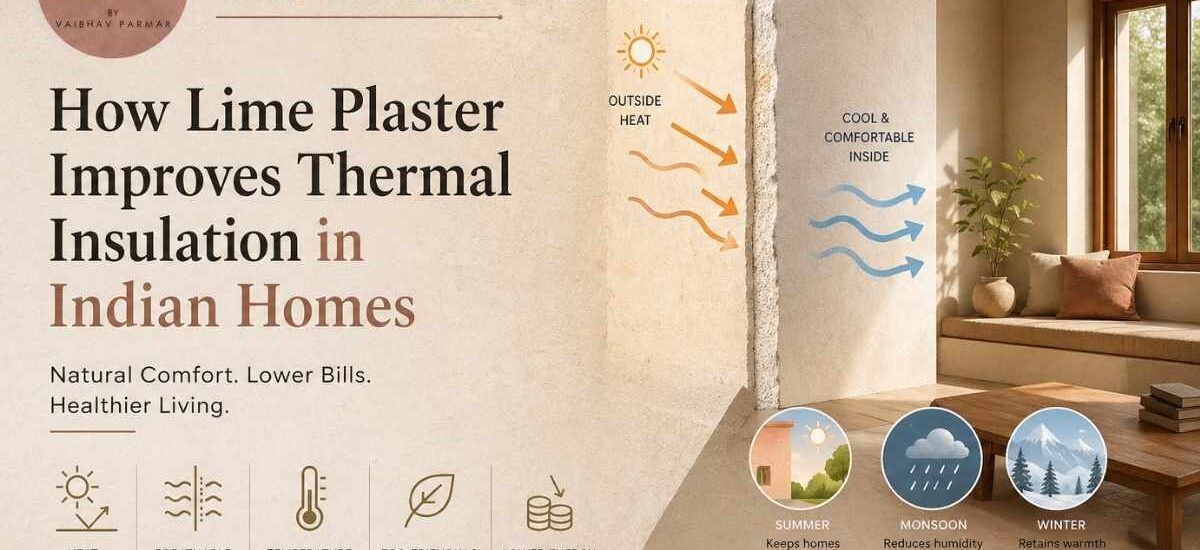
Instead of trapping heat, lime plaster helps in reducing heat transfer between the outside and inside.
That’s the core of thermal insulation.
1. Lime Plaster Reflects Heat Better
One of the biggest advantages is heat reflectivity.
Lime plaster surfaces reflect a portion of solar radiation instead of absorbing it completely. This reduces the amount of heat entering your home.
In practical terms:
- Exterior walls stay cooler
- Less heat passes indoors
This is especially useful in Indian summers where temperatures easily cross 40°C.
2. Breathability Reduces Heat Build-Up
Cement walls are sealed. Heat and moisture get trapped.
Lime plaster allows walls to breathe.
This means:
- Heat doesn’t get locked inside
- Moisture evaporates instead of accumulating
When moisture levels are controlled, indoor temperature feels more comfortable naturally.
This is why lime-plastered homes feel cooler even without heavy cooling systems.
3. Thermal Mass Works in Your Favor
Lime plaster has a different thermal behavior compared to cement.
It absorbs heat slowly and releases it gradually, creating a balanced indoor temperature.
So instead of:
- Sudden heat spikes during the day
- Heat retention at night
You get:
- More stable indoor conditions
- Reduced temperature fluctuations
This makes your home more livable throughout the day.
4. Works Perfectly with Indian Climate
India has extreme climate variations:
- Hot summers
- Humid monsoons
- Cool winters in some regions
Lime plaster adapts better to these conditions.
In Summers
- Reduces heat gain
- Keeps interiors cooler
In Monsoons
- Prevents moisture buildup
- Maintains indoor comfort
In Winters
- Slows down heat loss
- Keeps interiors more stable
It’s not just insulation. It’s climate adaptation.
5. Reduces Dependency on AC and Cooling Systems
Here’s the real benefit people care about.
If your walls are already controlling temperature, you don’t need to rely heavily on:
- Air conditioners
- Coolers
- Fans running constantly
This leads to:
- Lower electricity bills
- Less energy consumption
- More sustainable living
It’s not about eliminating AC. It’s about reducing dependency.
6. Long-Term Energy Savings
Most people look at construction cost but ignore operating cost.
A home that requires constant cooling:
- Costs more every month
- Wastes more energy
Lime plaster helps reduce that long-term burden.
Over time, the savings on electricity can balance out the initial cost difference compared to cement.
7. Works Even Better with Proper Design
Here’s something most people ignore.
Material alone is not enough.
If you combine lime plaster with smart design, results improve significantly:
- Proper wall thickness
- Shaded exteriors
- Ventilation planning
This is where working with an Architectural Design Consultant becomes valuable.
They ensure the material and design work together, not against each other.
8. Exterior Application Makes a Big Difference
Thermal performance improves significantly when lime plaster is used on exterior walls.
This creates a protective layer that:
- Reduces direct heat absorption
- Acts as a buffer between outside and inside
When done properly through a professional Lime Plaster Service, it can noticeably improve indoor comfort.
9. Araish Finish and Thermal Impact
Now, let’s address this.
Araish is mainly known for aesthetics. But it also contributes to thermal performance.
Its smooth, polished surface:
- Reflects heat better than rough cement finishes
- Adds a layer of insulation
While Araish Plaster in India is often used for interiors, it can still support overall thermal balance when combined with proper wall systems.
10. Common Mistakes That Ruin Thermal Benefits
Even the best material won’t work if applied incorrectly.
Here’s what people get wrong:
- Using incorrect mix ratios
- Skipping proper curing
- Applying lime like cement
- Not using it on exterior walls
These mistakes reduce effectiveness.
Lime plaster is not a shortcut solution. It requires proper technique.
When Lime Plaster Makes the Most Sense
You should seriously consider it if:
- Your home gets too hot in summer
- You want to reduce AC usage
- You’re building a long-term home
- You care about energy efficiency
It may not be ideal if:
- You’re rushing construction
- You want the cheapest option
- You don’t care about long-term comfort
Final Thoughts
Thermal insulation is not just about adding extra layers to your walls. It’s about choosing the right material from the start.
Lime plaster improves thermal performance by:
- Reflecting heat
- Allowing breathability
- Stabilizing indoor temperature
It doesn’t rely on artificial systems. It works naturally with your home.
But don’t expect magic if the execution is poor.
If applied correctly, lime plaster can make your home noticeably more comfortable and energy-efficient.
If applied carelessly, you’ll miss out on its biggest advantages.
So the real decision isn’t whether lime plaster works.
It’s whether you’re willing to use it the right way.