
In the world of modern construction, we have become accustomed to the idea of deterioration. We expect concrete to crack, paint to peel, and drywall to crumble. We build with materials that are rigid, brittle, and essentially “dead” from the moment they are installed. When a modern wall fails, it requires human intervention—patching, sanding, and repainting—to hide the scars.
But what if your walls could heal themselves?
It sounds like science fiction or nanotechnology, but this technology is thousands of years old. It is the secret reason why the Pantheon in Rome still stands, and why the ancient forts of Rajasthan endure centuries of monsoons and scorching heat.
The secret is lime.
At House of Lime, we often talk about the beauty and health benefits of natural finishes. But today, we are looking under the microscope. We are diving into the structural mechanics that make lime plaster one of the most resilient, durable, and chemically intelligent building materials on Earth.
The Myth of Strength: Hardness vs. Durability
To understand why lime is superior, we first have to unlearn a common misconception in modern engineering: that hardness equals durability.
Since the mid-20th century, the construction industry has been dominated by Ordinary Portland Cement (OPC). Cement is incredibly hard. It sets quickly and creates a rigid, unyielding barrier. In the short term, this seems ideal. However, buildings are not static objects. They move.
Buildings settle into their foundations. They expand in the summer heat and contract in the winter cold. They vibrate from passing traffic. When a building coated in rigid cement plaster shifts, the plaster cannot flex. It snaps. Micro-cracks form, and because the material is brittle, these cracks inevitably widen.
Lime plaster, by contrast, creates a finish that is softer than the masonry it covers. This “softness” is its greatest strength. Lime possesses a high modulus of elasticity, meaning it is flexible. When a building shifts, the lime plaster moves with it. It accommodates the thermal expansion and contraction without shearing off the wall. It is a protective skin that stretches rather than snaps.+2
Autogenous Healing: The Chemistry of Repair
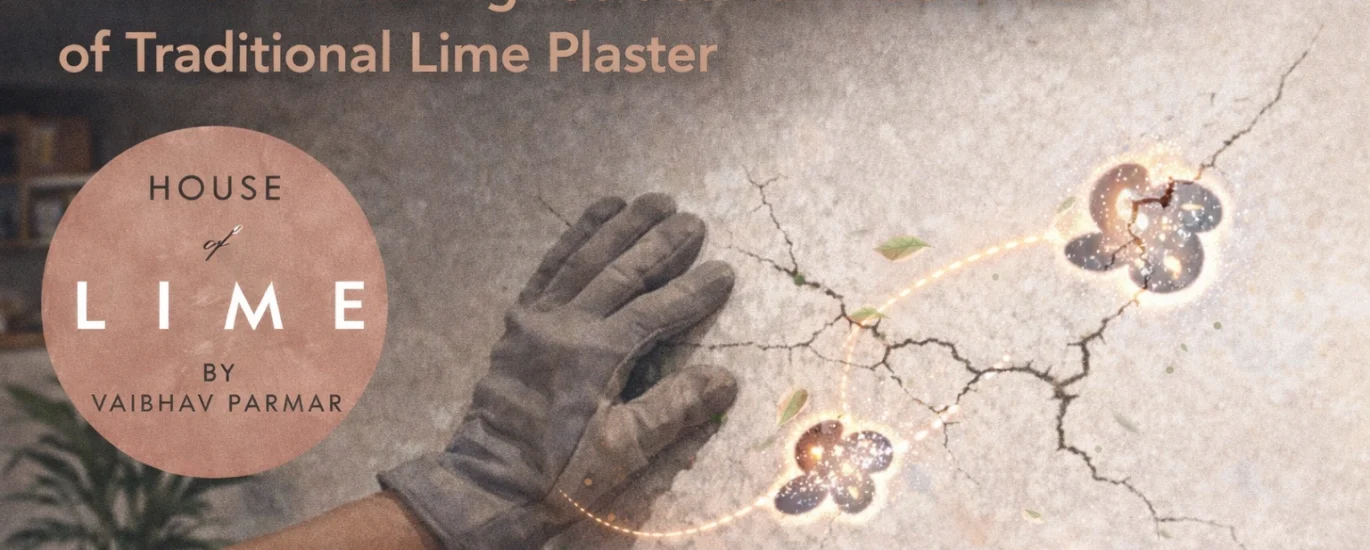
The most fascinating property of lime plaster is its ability to self-heal, a process technically known as “autogenous healing.”
This phenomenon occurs due to the unique way lime cures. As we discussed in previous articles, lime cures by absorbing carbon dioxide to return to its original state as limestone (calcium carbonate). However, even in a “cured” wall, there is often a reservoir of “free lime” (un-carbonated calcium hydroxide) remaining deep within the matrix of the plaster.
Here is what happens when a small crack does form in a lime wall:
- Rainwater or humidity penetrates the hairline crack.
- This moisture dissolves a small amount of the free lime hidden inside the plaster.
- The water, now carrying dissolved lime, travels to the surface of the crack.
- As the water evaporates, it deposits the lime.
- This deposited lime reacts with carbon dioxide in the air and carbonates, turning into solid stone (calcium carbonate).
Essentially, the wall uses the very agent of decay—water—to trigger a repair mechanism. The crack fills itself with new limestone crystals, sealing the breach and restoring the integrity of the surface.
This is why ancient aqueducts and harbor walls built with lime mortar have survived for millennia. They are constantly healing the minor damage inflicted upon them by the elements.
Sacrificial Protection: Saving the Structure
In heritage conservation, there is a golden rule: the mortar and plaster should always be softer than the brick or stone they cover.
Modern cement render violates this rule. Because cement is impermeable and harder than older bricks or porous stones, it traps moisture inside the wall. When that trapped moisture freezes or expands with heat, it has nowhere to go. Since the cement won’t give way, the pressure destroys the softer brick underneath. This leads to “spalling,” where the face of the brick literally explodes off inside the wall. We have seen countless historic buildings ruined by well-intentioned renovations using cement.
Lime plaster acts as a “sacrificial” layer. Because it is highly breathable (vapor permeable), it draws moisture out of the structural masonry and allows it to evaporate. It keeps the structural core of the building dry. If there is extreme salt damage or weathering, the lime plaster will take the hit, crumbling slowly over time to save the expensive stone or brickwork underneath.+1
Replacing a layer of plaster is cheap and easy. Replacing the structural foundation of a house is not. By using lime, you are actively preserving the lifespan of the building’s skeleton.
The Royal Standard: Araish and Structural Integrity
While the mechanics of lime are rugged, the finish need not be rustic. The structural benefits of lime are perhaps most beautifully disguised in the technique of Araish Plaster in India.
Araish is often celebrated solely for its mirror-like, marble finish. However, the technique itself is a masterclass in structural layering. It involves applying multiple coats of progressively finer lime mortar. The base layers provide the flexibility and breathability, while the final layer—created with finely ground marble dust and lime—is burnished to a high gloss.
This burnishing process compresses the surface, making it incredibly dense and water-resistant (though still vapor permeable). In the stepwells and palaces of India, Araish wasn’t just decoration; it was waterproofing. It protected the walls from the ravages of water while allowing the structure to breathe. It is a perfect example of how traditional engineering combined structural utility with unmatched aesthetics.
Why Modern Homes Need Ancient Tech
One might assume that these properties are only relevant for old stone cottages or heritage forts. This is untrue. Modern construction materials, such as clay blocks, AAC blocks, and even timber frames, all benefit from the flexibility and breathability of lime.
Modern homes are often plagued by damp issues because they are wrapped in plastic barriers and non-breathable paints. By using lime plaster, you introduce a regulating membrane that manages moisture and prevents the structural decay of modern materials just as effectively as it does ancient ones.
However, integrating this “living” material into a modern build requires expertise. You cannot simply treat lime like cement. The mix ratios, the sand selection, and the curing times are critical. This is where the role of an Architectural Design Consultant becomes vital.
A consultant bridges the gap between modern architectural requirements and traditional material science. We analyze the substrate of your building to determine the correct hydraulic strength of the lime needed. We ensure that the specification allows for that crucial flexibility, preventing the common mistakes that lead to failure.
The Longevity Economy
There is a perception that lime plaster is expensive. If you look strictly at the upfront cost of a bag of lime versus a bag of cement, that may appear true. But if you look at the lifecycle cost of the building, the equation flips.
A cement-rendered wall may need painting every 5 years and significant patch repairs every 10 to 15 years as it cracks and delaminates. A well-applied lime plaster, due to its self-healing nature and flexibility, can last for decades—and in many cases, centuries—with minimal maintenance.
It does not peel because it is not a plastic skin glued to the surface; it is the surface. It does not rot the underlying brickwork, saving you from catastrophic structural repairs down the road. When you pay for a professional Lime Plaster Service, you are investing in a finish that will likely outlive your tenure in the home.
Conclusion: Building for the Future with the Past
We are living in an era where “sustainable” often means “high-tech.” We look for smart sensors and synthetic eco-materials. But true sustainability is durability. The most sustainable building is the one that does not need to be torn down and rebuilt every forty years.
Lime plaster offers a path back to permanence. It offers a way to build homes that work in harmony with the environment, healing themselves through the simple chemistry of water and air, and protecting the structures we live in.
Whether you are charmed by the marble-smooth touch of Araish or simply want a home that won’t trap moisture and rot, the structural arguments for lime are as compelling as the aesthetic ones.
At House of Lime, we don’t just apply a finish; we apply a philosophy of longevity. Let us help you build walls that are designed to last.